Theileria annulata-infected host leukocytes exhibit cancer-like phenotypes, driven by mechanisms that remain incompletely understood. This study explores the genomic alterations underlying these transformations using whole-genome sequencing and bioinformatic analyses of six clinically relevant T. annulata-infected cell lines. Here we identify 7867 exon-linked somatic mutations shared across all cell lines, with significant enrichment in oncogenes (e.g., FLT4, NOTCH2, MAP3K1, DAXX, FCGR2B, ROS1) and tumor suppressor genes (e.g., BARD1, KMT2C, GRIN2A, BAP1). These mutations are associated with critical cancer-related pathways. Functional studies revealed that inhibition of the mutated oncogene ROS1 using crizotinib induces death in infected leukocytes, confirming its role in transformation. Additionally, we observe mutations in genes linked to genomic instability and the DNA damage response (DDR) pathways, highlighting potential parallels with cancer biology. Suppression of TP53, a key tumor suppressor, is implicated in the immortalization of infected cells, while upregulation of the DNA mutator enzyme APOBEC3H suggests a parasite-driven, mutation-inducing mechanism. Our findings provide new insights into how T. annulata reprograms host cells through genomic instability and mutations, identifying ROS1 and TP53 as critical targets for therapeutic intervention. This work advances understanding of parasite-induced oncogenic transformation and offers pathways for future research.
© 2025. The Author(s).
Product Citations: 8

Genomic characterization of host gene alterations in Theileria annulata-transformed leukocytes.
In Communications Biology on 20 November 2025 by Dandasena, D., Suresh, A., et al.
In International Journal of Molecular Sciences on 22 December 2024 by Rivas, S., Sepúlveda, R. V., et al.
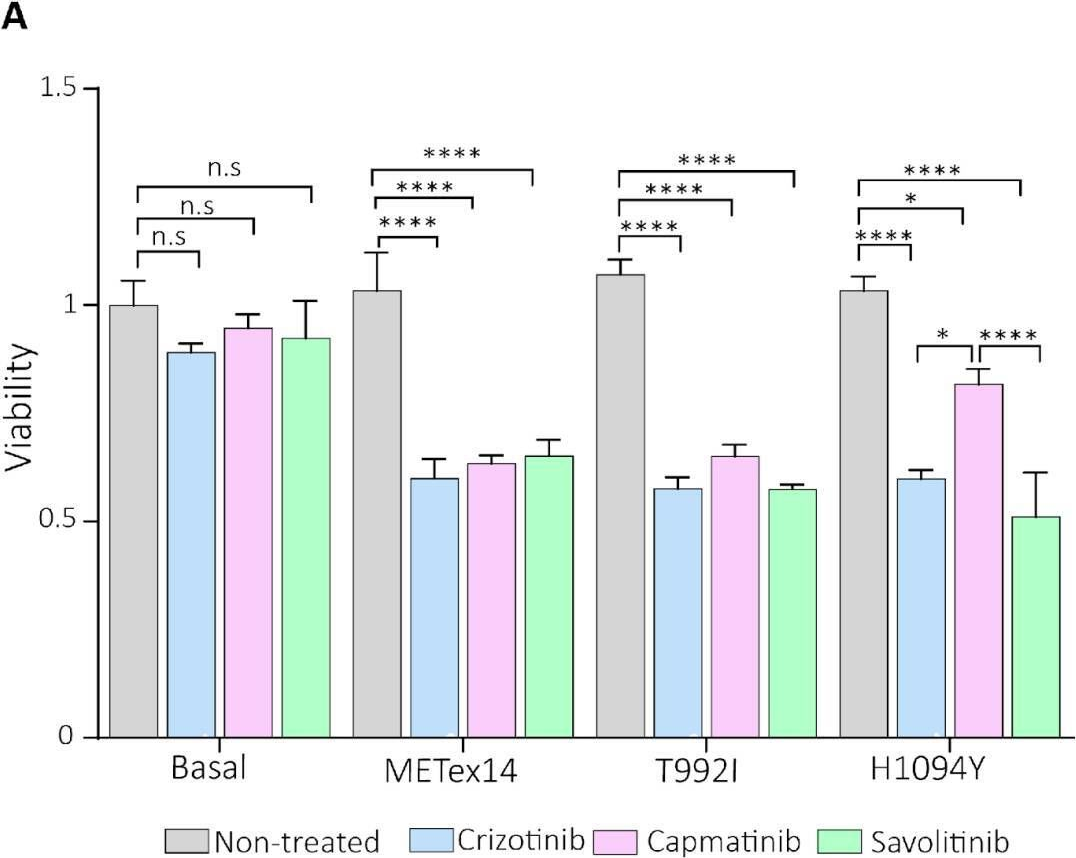
Targeted therapy indications for actionable variants in non-small-cell lung cancer (NSCLC) have primarily been studied in Caucasian populations, with limited data on Latin American patients. This study utilized a 52-genes next-generation sequencing (NGS) panel to analyze 1560 tumor biopsies from NSCLC patients in Chile, Brazil, and Peru. The RNA sequencing reads and DNA coverage were correlated to improve the detection of the actionable MET exon 14 skipping variant (METex14). The pathogenicity of MET variants of uncertain significance (VUSs) was assessed using bioinformatic methods, based on their predicted driver potential. The effects of the predicted drivers VUS T992I and H1094Y on c-MET signaling activation, proliferation, and migration were evaluated in HEK293T, BEAS-2B, and H1993 cell lines. Subsequently, c-Met inhibitors were tested in 2D and 3D cell cultures, and drug affinity was determined using 3D structure simulations. The prevalence of MET variants in the South American cohort was 8%, and RNA-based diagnosis detected 27% more cases of METex14 than DNA-based methods. Notably, 20% of METex14 cases with RNA reads below the detection threshold were confirmed using DNA analysis. The novel actionable T992I and H1094Y variants induced proliferation and migration through c-Met/Akt signaling. Both variants showed sensitivity to crizotinib and savolitinib, but the H1094Y variant exhibited reduced sensitivity to capmatinib. These findings highlight the importance of RNA-based METex14 diagnosis and reveal the drug sensitivity profiles of novel actionable MET variants from an understudied patient population.
In Cell Host & Microbe on 12 June 2024 by Simpson, J. B., Walker, M. E., et al.
Hormones and neurotransmitters are essential to homeostasis, and their disruptions are connected to diseases ranging from cancer to anxiety. The differential reactivation of endobiotic glucuronides by gut microbial β-glucuronidase (GUS) enzymes may influence interindividual differences in the onset and treatment of disease. Using multi-omic, in vitro, and in vivo approaches, we show that germ-free mice have reduced levels of active endobiotics and that distinct gut microbial Loop 1 and FMN GUS enzymes drive hormone and neurotransmitter reactivation. We demonstrate that a range of FDA-approved drugs prevent this reactivation by intercepting the catalytic cycle of the enzymes in a conserved fashion. Finally, we find that inhibiting GUS in conventional mice reduces free serotonin and increases its inactive glucuronide in the serum and intestines. Our results illuminate the indispensability of gut microbial enzymes in sustaining endobiotic homeostasis and indicate that therapeutic disruptions of this metabolism promote interindividual response variabilities.
Copyright © 2024 The Author(s). Published by Elsevier Inc. All rights reserved.
Preprint on BioRxiv : the Preprint Server for Biology on 21 February 2024 by Dandesena, D., Suresh, A., et al.
Theileria annulata -infected host leukocytes display cancer-like phenotypes, though the precise mechanism is yet to be fully understood. The occurrence of cancer-like phenotypes in Theileria -infected leukocytes may be attributed to various factors, including genomic instability and acquired mutations, a crucial trait that underpins the genetic foundation of cancer. This paper presents WGS data and bioinformatic analyses to reveal point mutations and large-scale alterations in six clinically relevant T. annulata -infected cell lines. We identified 7867 exon-linked somatic mutations common to all cell lines, and cancer association analysis showed significant accumulation in oncogenes (FLT4, NOTCH2, MAP3K1, DAXX, FCGR2B, ROS1) and tumor suppressor genes (BARD1, KMT2C, GRIN2A, BAP1) implicated in established critical cancer processes. We demonstrated that a crizotinib-induced blockade of the ROS1 oncogenic protein, which harbored the most mutations, led to the death of infected leukocytes. This is consistent with the significant role of ROS1 in parasite-induced leukocyte transformation. In addition, we found somatic mutations in genes involved in genome instability and the DDR pathway. Our findings support the notion that ROS1 and Nutulin 3a are valid targets for intervention, and the suppression of TP53, a crucial tumor suppressor gene, may play a significant role in cell immortalization. We also show that upon infection with the parasite, bovine cells upregulate the expression of APOBEC3H, a DNA mutator likely responsible for the detected mutations. Our study highlights how T. annulata transforms leukocytes to gain selective advantage via mutation, and our observations could steer future research towards a mechanistic understanding of disease pathogenesis.
Somatic gain-of-function mutations in BUD13 promote oncogenesis by disrupting Fbw7 function.
In The Journal of Experimental Medicine on 2 October 2023 by Chen, J., Zhang, X., et al.
Somatic mutations occurring on key enzymes are extensively studied and targeted therapies are developed with clinical promises. However, context-dependent enzyme function through distinct substrates complicated targeting a given enzyme. Here, we develop an algorithm to elucidate a new class of somatic mutations occurring on enzyme-recognizing motifs that cancer may hijack to facilitate tumorigenesis. We validate BUD13-R156C and -R230Q mutations evading RSK3-mediated phosphorylation with enhanced oncogenicity in promoting colon cancer growth. Further mechanistic studies reveal BUD13 as an endogenous Fbw7 inhibitor that stabilizes Fbw7 oncogenic substrates, while cancerous BUD13-R156C or -R230Q interferes with Fbw7Cul1 complex formation. We also find this BUD13 regulation plays a critical role in responding to mTOR inhibition, which can be used to guide therapy selections. We hope our studies reveal the landscape of enzyme-recognizing motif mutations with a publicly available resource and provide novel insights for somatic mutations cancer hijacks to promote tumorigenesis with the potential for patient stratification and cancer treatment.
© 2023 Chen et al.
In Int J Mol Sci on 22 December 2024 by Rivas, S., Sepúlveda, R. V., et al.
Fig.6.A
Collected and cropped from International Journal of Molecular Sciences by CiteAb, provided under a CC-BY license
Image 1 of 1