Despite significant progress in the treatment of patients with diffuse large B-cell lymphoma (DLBCL) and mantle cell lymphoma (MCL), the prognosis of patients with relapsed disease remains poor due to the emergence of drug resistance and subsequent disease progression. Identification of novel targets and therapeutic strategies for these diseases represents an urgent need. Here, we report that both MCL and DLBCL are exquisitely sensitive to transcription-targeting drugs, in particular THZ531, a covalent inhibitor of cyclin-dependent kinase 12 (CDK12). By implementing pharmacogenomics and a cell-based drug screen, we found that THZ531 leads to inhibition of oncogenic transcriptional programs, especially the DNA damage response pathway, MYC target genes and the mTOR-4EBP1-MCL-1 axis, contributing to dramatic lymphoma suppression in vitro. We also identified de novo and established acquired THZ531-resistant lymphoma cells conferred by over-activation of the MEK-ERK and PI3K-AKT-mTOR pathways and upregulation of multidrug resistance-1 (MDR1) protein. Of note, EZH2 inhibitors reversed resistance to THZ531 by competitive inhibition of MDR1 and, in combination with THZ531, synergistically inhibited MCL and DLBCL growth in vitro. Our study indicates that CDK12 inhibitors, alone or together with EZH2 inhibitors, offer promise as novel effective approaches for difficult-to-treat DLBCL and MCL.
Product Citations: 5

Response and resistance to CDK12 inhibition in aggressive B-cell lymphomas.
In Haematologica on 1 May 2022 by Gao, J., Wang, M. Y., et al.
Transcriptional programming drives Ibrutinib-resistance evolution in mantle cell lymphoma.
In Cell Reports on 16 March 2021 by Zhao, X., Wang, M. Y., et al.
Ibrutinib, a bruton's tyrosine kinase (BTK) inhibitor, provokes robust clinical responses in aggressive mantle cell lymphoma (MCL), yet many patients relapse with lethal Ibrutinib-resistant (IR) disease. Here, using genomic, chemical proteomic, and drug screen profiling, we report that enhancer remodeling-mediated transcriptional activation and adaptive signaling changes drive the aggressive phenotypes of IR. Accordingly, IR MCL cells are vulnerable to inhibitors of the transcriptional machinery and especially so to inhibitors of cyclin-dependent kinase 9 (CDK9), the catalytic subunit of the positive transcription elongation factor b (P-TEFb) of RNA polymerase II (RNAPII). Further, CDK9 inhibition disables reprogrammed signaling circuits and prevents the emergence of IR in MCL. Finally, and importantly, we find that a robust and facile ex vivo image-based functional drug screening platform can predict clinical therapeutic responses of IR MCL and identify vulnerabilities that can be targeted to disable the evolution of IR.Copyright © 2021 The Author(s). Published by Elsevier Inc. All rights reserved.
Type I PRMT Inhibition Protects Against C9ORF72 Arginine-Rich Dipeptide Repeat Toxicity.
In Frontiers in Pharmacology on 6 October 2020 by Premasiri, A. S., Gill, A. L., et al.
Repeat expansion mutations in the C9ORF72 gene are the most common genetic cause of amyotrophic lateral sclerosis (ALS) and frontotemporal dementia (FTD). Repeat-associated non-AUG translation of this expansion produces dipeptide repeat proteins (DRPs). The arginine containing DRPs, polyGR and polyPR, are consistently reported to be the most toxic. Here we demonstrated that small molecule inhibition of type I protein arginine methyltransferases (PRMT) protects against polyGR and polyPR toxicity. Furthermore, our findings suggest that asymmetric dimethylation of polyGR and polyPR by Type I PRMTs plays important roles in their cytotoxicity.
Copyright © 2020 Premasiri, Gill and Vieira.
Immunogenicity of prostate cancer is augmented by BET bromodomain inhibition.
In Journal for Immunotherapy of Cancer on 25 October 2019 by Mao, W., Ghasemzadeh, A., et al.
Prostate cancer responds poorly to current immunotherapies. Epigenetic therapies such as BET Bromodomain inhibition can change the transcriptome of tumor cells, possibly making them more immunogenic and thus susceptible to immune targeting.
We characterized the effects of BET bromodomain inhibition using JQ1 on PD-L1 and HLA-ABC expression in two human prostate cell lines, DU145 and PC3. RNA-Seq was performed to assess changes on a genome-wide level. A cytotoxic T cell killing assay was performed in MC38-OVA cells treated with JQ1 to demonstrate increased immunogenicity. In vivo experiments in the Myc-Cap model were conducted to show the effects of JQ1 administration in concert with anti-CTLA-4 checkpoint blockade.
Here, we show that targeting BET bromodomains using the small molecule inhibitor JQ1 decreased PD-L1 expression and mitigated tumor progression in prostate cancer models. Mechanistically, BET bromodomain inhibition increased MHC I expression and increased the immunogenicity of tumor cells. Transcriptional profiling showed that BET bromodomain inhibition regulates distinct networks of antigen processing and immune checkpoint molecules. In murine models, treatment with JQ1 was additive with anti-CTLA-4 immunotherapy, resulting in an increased CD8/Treg ratio.
BET Bromodomain inhibition can mediate changes in expression at a genome wide level in prostate cancer cells, resulting in an increased susceptibility to CD8 T cell targeting. These data suggest that combining BET bromodomain inhibition with immune checkpoint blockade may have clinical activity in prostate cancer patients.
In Cancer Cell on 13 May 2019 by Zhao, X., Ren, Y., et al.
Drug-tolerant "persister" tumor cells underlie emergence of drug-resistant clones and contribute to relapse and disease progression. Here we report that resistance to the BCL-2 targeting drug ABT-199 in models of mantle cell lymphoma and double-hit lymphoma evolves from outgrowth of persister clones displaying loss of 18q21 amplicons that harbor BCL2. Further, persister status is generated via adaptive super-enhancer remodeling that reprograms transcription and offers opportunities for overcoming ABT-199 resistance. Notably, pharmacoproteomic and pharmacogenomic screens revealed that persisters are vulnerable to inhibition of the transcriptional machinery and especially to inhibition of cyclin-dependent kinase 7 (CDK7), which is essential for the transcriptional reprogramming that drives and sustains ABT-199 resistance. Thus, transcription-targeting agents offer new approaches to disable drug resistance in B-cell lymphomas.
Copyright © 2019 Elsevier Inc. All rights reserved.
In J Immunother Cancer on 25 October 2019 by Mao, W., Ghasemzadeh, A., et al.
Fig.1.A
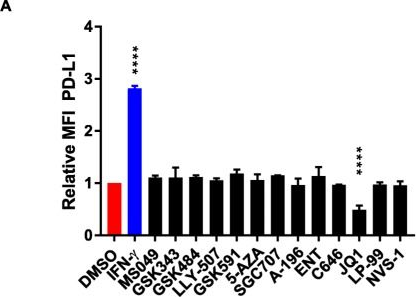
Collected and cropped from Journal for Immunotherapy of Cancer by CiteAb, provided under a CC-BY license
Image 1 of 1