Rift Valley fever virus (RVFV) is an arthropod-borne bunyavirus that can cause serious and fatal disease in humans and animals. RVFV is a negative-sense RNA virus of the Phlebovirus genus in the Bunyaviridae family. The main envelope RVFV glycoproteins, Gn and Gc, are encoded on the M segment of RVFV and known inducers of protective immunity. In an attempt to develop a safe and efficacious RVF vaccine, we constructed and tested a vectored equine herpesvirus type 1 (EHV-1) vaccine that expresses RVFV Gn and Gc. The Gn and Gc genes were custom-synthesized after codon optimization and inserted into EHV-1 strain RacH genome. The rH_Gn-Gc recombinant virus grew in cultured cells with kinetics that were comparable to those of the parental virus and stably expressed Gn and Gc. Upon immunization of sheep, the natural host, neutralizing antibodies against RVFV were elicited by rH_Gn-Gc and protective titers reached to 1:320 at day 49 post immunization but not by parental EHV-1, indicating that EHV-1 is a promising vector alternative in the development of a safe marker RVFV vaccine.
Product Citations: 6

Applications
Reactivity
Research Area
In Virology Journal on 14 August 2017 by Said, A., Elmanzalawy, M., et al.
-
ICC-IF
-
Oryctolagus cuniculus (Rabbit)
-
Immunology and Microbiology
-
Veterinary Research
Protein Phosphatase-1 regulates Rift Valley fever virus replication.
In Antiviral Research on 1 March 2016 by Baer, A., Shafagati, N., et al.
Rift Valley fever virus (RVFV), genus Phlebovirus family Bunyaviridae, is an arthropod-borne virus endemic throughout sub-Saharan Africa. Recent outbreaks have resulted in cyclic epidemics with an increasing geographic footprint, devastating both livestock and human populations. Despite being recognized as an emerging threat, relatively little is known about the virulence mechanisms and host interactions of RVFV. To date there are no FDA approved therapeutics or vaccines for RVF and there is an urgent need for their development. The Ser/Thr protein phosphatase 1 (PP1) has previously been shown to play a significant role in the replication of several viruses. Here we demonstrate for the first time that PP1 plays a prominent role in RVFV replication early on during the viral life cycle. Both siRNA knockdown of PP1α and a novel PP1-targeting small molecule compound 1E7-03, resulted in decreased viral titers across several cell lines. Deregulation of PP1 was found to inhibit viral RNA production, potentially through the disruption of viral RNA transcript/protein interactions, and indicates a potential link between PP1α and the viral L polymerase and nucleoprotein. These results indicate that PP1 activity is important for RVFV replication early on during the viral life cycle and may prove an attractive therapeutic target.Copyright © 2016 Elsevier B.V. All rights reserved.
-
WB
-
Immunology and Microbiology
Curcumin inhibits Rift Valley fever virus replication in human cells.
In The Journal of Biological Chemistry on 28 September 2012 by Narayanan, A., Kehn-Hall, K., et al.
Rift Valley fever virus (RVFV) is an arbovirus that is classified as a select agent, an emerging infectious virus, and an agricultural pathogen. Understanding RVFV-host interactions is imperative to the design of novel therapeutics. Here, we report that an infection by the MP-12 strain of RVFV induces phosphorylation of the p65 component of the NFκB cascade. We demonstrate that phosphorylation of p65 (serine 536) involves phosphorylation of IκBα and occurs through the classical NFκB cascade. A unique, low molecular weight complex of the IKK-β subunit can be observed in MP-12-infected cells, which we have labeled IKK-β2. The IKK-β2 complex retains kinase activity and phosphorylates an IκBα substrate. Inhibition of the IKK complex using inhibitors impairs viral replication, thus alluding to the requirement of an active IKK complex to the viral life cycle. Curcumin strongly down-regulates levels of extracellular infectious virus. Our data demonstrated that curcumin binds to and inhibits kinase activity of the IKK-β2 complex in infected cells. Curcumin partially exerts its inhibitory influence on RVFV replication by interfering with IKK-β2-mediated phosphorylation of the viral protein NSs and by altering the cell cycle of treated cells. Curcumin also demonstrated efficacy against ZH501, the fully virulent version of RVFV. Curcumin treatment down-regulated viral replication in the liver of infected animals. Our data point to the possibility that RVFV infection may result in the generation of novel versions of host components (such as IKK-β2) that, by virtue of altered protein interaction and function, qualify as unique therapeutic targets.
-
WB
-
Biochemistry and Molecular biology
-
Immunology and Microbiology
Creation of a recombinant Rift Valley fever virus with a two-segmented genome.
In Journal of Virology on 1 October 2011 by Brennan, B., Welch, S. R., et al.
Rift Valley fever virus (RVFV; family Bunyaviridae) is a clinically important, mosquito-borne pathogen of both livestock and humans, which is found mainly in sub-Saharan Africa and the Arabian Peninsula. RVFV has a trisegmented single-stranded RNA (ssRNA) genome. The L and M segments are negative sense and encode the L protein (viral polymerase) on the L segment and the virion glycoproteins Gn and Gc as well as two other proteins, NSm and 78K, on the M segment. The S segment uses an ambisense coding strategy to express the nucleocapsid protein, N, and the nonstructural protein, NSs. Both the NSs and NSm proteins are dispensable for virus growth in tissue culture. Using reverse genetics, we generated a recombinant virus, designated r2segMP12, containing a two-segmented genome in which the NSs coding sequence was replaced with that for the Gn and Gc precursor. Thus, r2segMP12 lacks an M segment, and although it was attenuated in comparison to the three-segmented parental virus in both mammalian and insect cell cultures, it was genetically stable over multiple passages. We further show that the virus can stably maintain an M-like RNA segment encoding the enhanced green fluorescent protein gene. The implications of these findings for RVFV genome packaging and the potential to develop multivalent live-attenuated vaccines are discussed.
-
WB
-
Immunology and Microbiology
In PLoS ONE on 10 June 2011 by Narayanan, A., Popova, T., et al.
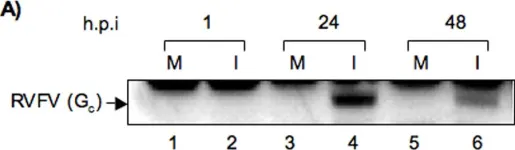
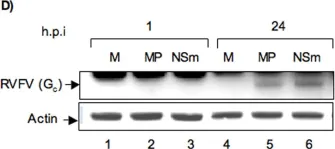
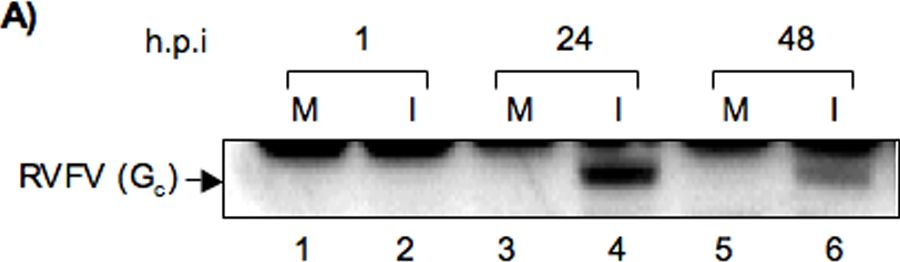
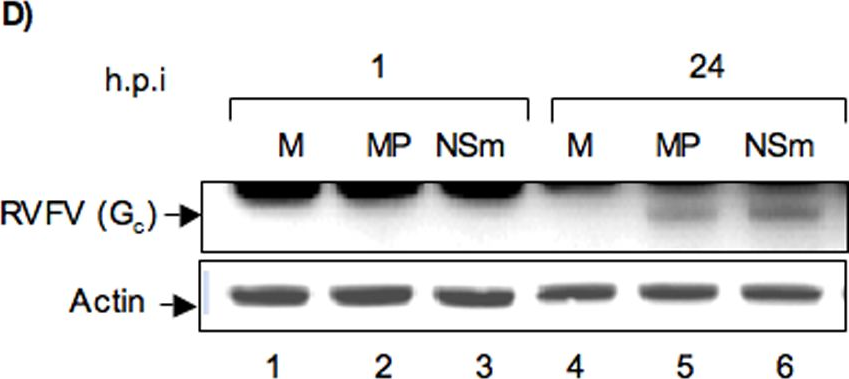
Rift Valley fever (RVF) is a zoonotic disease caused by Rift Valley fever virus (RVFV). RVFV is a category A pathogen that belongs to the genus Phlebovirus, family Bunyaviridae. Understanding early host events to an infectious exposure to RVFV will be of significant use in the development of effective therapeutics that not only control pathogen multiplication, but also contribute to cell survival. In this study, we have carried out infections of human cells with a vaccine strain (MP12) and virulent strain (ZH501) of RVFV and determined host responses to viral infection. We demonstrate that the cellular antioxidant enzyme superoxide dismutase 1 (SOD1) displays altered abundances at early time points following exposure to the virus. We show that the enzyme is down regulated in cases of both a virulent (ZH501) and a vaccine strain (MP12) exposure. Our data demonstrates that the down regulation of SOD1 is likely to be due to post transcriptional processes and may be related to up regulation of TNFα following infection. We also provide evidence for extensive oxidative stress in the MP12 infected cells. Concomitantly, there is an increase in the activation of the p38 MAPK stress response, which our earlier published study demonstrated to be an essential cell survival strategy. Our data suggests that the viral anti-apoptotic protein NSm may play a role in the regulation of the cellular p38 MAPK response. Alterations in the host protein SOD1 following RVFV infection appears to be an early event that occurs in multiple cell types. Activation of the cellular stress response p38 MAPK pathway can be observed in all cell types tested. Our data implies that maintaining oxidative homeostasis in the infected cells may play an important role in improving survival of infected cells.
-
WB
-
Homo sapiens (Human)
-
Immunology and Microbiology
In PLoS One on 10 June 2011 by Narayanan, A., Popova, T., et al.
Fig.1.A
-
WB
-
Homo sapiens (Human)
Collected and cropped from PLoS ONE by CiteAb, provided under a CC-BY license
Image 1 of 2
In PLoS One on 10 June 2011 by Narayanan, A., Popova, T., et al.
Fig.5.D
-
WB
-
Homo sapiens (Human)
Collected and cropped from PLoS ONE by CiteAb, provided under a CC-BY license
Image 1 of 2