The irreversible loss of cardiomyocytes due to oxidative stress is the main cause of heart dysfunction following ischemia/reperfusion (I/R) injury and ageing-induced cardiomyopathy. Here, we report that CUEDC2, a CUE domain-containing protein, plays a critical role in oxidative stress-induced cardiac injury. Cuedc2(-/-) cardiomyocytes exhibited a greater resistance to oxidative stress-induced cell death. Loss of CUEDC2 enhanced the antioxidant capacity of cardiomyocytes, promoted reactive oxygen species (ROS) scavenging, and subsequently inhibited the redox-dependent activation of signaling pathways. Notably, CUEDC2 promoted E3 ubiquitin ligases tripartite motif-containing 33 (TRIM33)-mediated the antioxidant enzyme, glutathione peroxidase 1 (GPX1) ubiquitination, and proteasome-dependent degradation. Ablation of CUEDC2 upregulated the protein level of GPX1 in the heart significantly. Strikingly, in vivo, the infarct size of Cuedc2(-/-) heart was significantly decreased after I/R injury, and aged Cuedc2(-/-) mice preserved better heart function as the overall ROS levels in their hearts were significantly lower. Our results demonstrated a novel role of CUEDC2 in cardiomyocyte death regulation. Manipulating CUEDC2 level might be an attractive therapeutic strategy for promoting cardiomyocyte survival following oxidative stress-induced cardiac injury.
© 2016 The Authors. Published under the terms of the CC BY 4.0 license.
Product Citations: 1
Powered by

Applications
WB
Reactivity
Mus musculus (House mouse)
Research Area
Biochemistry and Molecular biology
CUEDC2 modulates cardiomyocyte oxidative capacity by regulating GPX1 stability.
In EMBO Molecular Medicine on 1 July 2016 by Jian, Z., Liang, B., et al.
-
WB
-
Mus musculus (House mouse)
-
Biochemistry and Molecular biology
Show More
Show Less
In EMBO Mol Med on 1 July 2016 by Jian, Z., Liang, B., et al.
Fig.1.B
-
WB
-
Mus musculus (House mouse)
CUEDC2 degradation was induced by ischemia/reperfusion in cardiac tissueCUEDC2 protein levels in mouse tissues. Adult (12‐week‐old) mouse was sacrificed and the total protein was extracted from the liver, kidney, lung, spleen, heart, stomach, intestine, prostate, testis, brain, and thymus.(top) I...
more
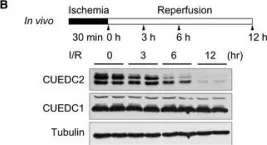
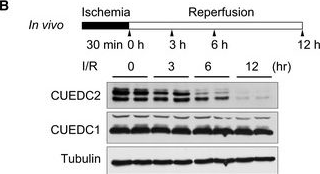
CUEDC2 degradation was induced by ischemia/reperfusion in cardiac tissueCUEDC2 protein levels in mouse tissues. Adult (12‐week‐old) mouse was sacrificed and the total protein was extracted from the liver, kidney, lung, spleen, heart, stomach, intestine, prostate, testis, brain, and thymus.(top) In vivo cardiac ischemia/reperfusion model protocol (30‐minute ischemia followed by indicated times of reperfusion). (bottom) Mice were subjected to reversible ischemia in vivo for 30 min and reperfused for different time periods. Protein was extracted from the area at risk of heart at the indicated time points and subjected to immunoblot analysis of CUEDC2 and CUEDC1. Representative results were shown from 2 mice at each time point, and experiments were repeated for three times.Isolated primary rat neonatal cardiomyocytes were subjected to hypoxia with serum‐free medium for 6 h and reoxygenated accompanying adding serum back for different time period in vitro and the protein level of CUEDC2 was tested at different time points during reoxygenation. Each experiment was repeated for three times.CUEDC2 protein level was plotted using the immunohistochemical scores as described in methods. (left) Plot of CUEDC2 scores in each BZ and DZ (n = 9 patients). (right) Representative images from immunohistochemical staining for CUEDC2 in the tissues from patients who suffered acute myocardial infarctions. The boxed areas in the left images are magnified in the middle and right images. DZ, distant zone; BZ, border zone. Scale bars, 250 μm (left), 50 μm (middle and right). *P = 0.001. Data were shown as mean ± SEM and analyzed by paired t‐test.Source data are available online for this figure.
less
Collected and cropped from EMBO Molecular Medicine by CiteAb, provided under a CC-BY license
Image 1 of 1