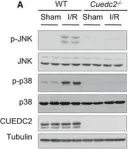
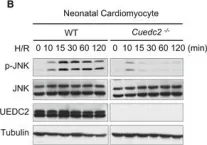
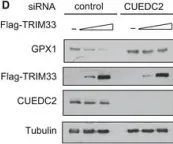
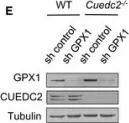
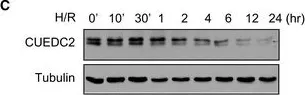
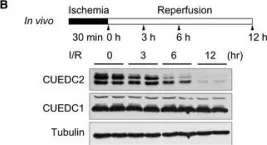
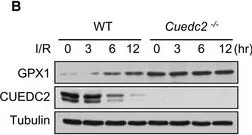
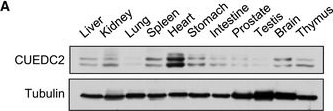
The irreversible loss of cardiomyocytes due to oxidative stress is the main cause of heart dysfunction following ischemia/reperfusion (I/R) injury and ageing-induced cardiomyopathy. Here, we report that CUEDC2, a CUE domain-containing protein, plays a critical role in oxidative stress-induced cardiac injury. Cuedc2(-/-) cardiomyocytes exhibited a greater resistance to oxidative stress-induced cell death. Loss of CUEDC2 enhanced the antioxidant capacity of cardiomyocytes, promoted reactive oxygen species (ROS) scavenging, and subsequently inhibited the redox-dependent activation of signaling pathways. Notably, CUEDC2 promoted E3 ubiquitin ligases tripartite motif-containing 33 (TRIM33)-mediated the antioxidant enzyme, glutathione peroxidase 1 (GPX1) ubiquitination, and proteasome-dependent degradation. Ablation of CUEDC2 upregulated the protein level of GPX1 in the heart significantly. Strikingly, in vivo, the infarct size of Cuedc2(-/-) heart was significantly decreased after I/R injury, and aged Cuedc2(-/-) mice preserved better heart function as the overall ROS levels in their hearts were significantly lower. Our results demonstrated a novel role of CUEDC2 in cardiomyocyte death regulation. Manipulating CUEDC2 level might be an attractive therapeutic strategy for promoting cardiomyocyte survival following oxidative stress-induced cardiac injury.
© 2016 The Authors. Published under the terms of the CC BY 4.0 license.
Product Citations: 2

Applications
Reactivity
Research Area
CUEDC2 modulates cardiomyocyte oxidative capacity by regulating GPX1 stability.
In EMBO Molecular Medicine on 1 July 2016 by Jian, Z., Liang, B., et al.
-
WB
-
Mus musculus (House mouse)
-
Biochemistry and Molecular biology
In Cell Reports on 26 June 2014 by Chen, Y., Wang, S. X., et al.
CUEDC2, a CUE-domain-containing protein, modulates inflammation, but its involvement in tumorigenesis is still poorly understood. Here, we report that CUEDC2 is a key regulator of macrophage function and critical for protection against colitis-associated tumorigenesis. CUEDC2 expression is dramatically upregulated during macrophage differentiation, and CUEDC2 deficiency results in excessive production of proinflammatory cytokines. The level of CUEDC2 in macrophages is modulated by miR- 324-5p. We find that Cuedc2 KO mice are more susceptible to dextran-sodium-sulfate-induced colitis, and macrophage transplantation results suggest that the increased susceptibility results from the dysfunction of macrophages lacking CUEDC2. Furthermore, we find that Cuedc2 KO mice are more prone to colitis-associated cancer. Importantly, CUEDC2 expression is almost undetectable in macrophages in human colon cancer, and this decreased CUEDC2 expression is associated with high levels of interleukin-4 and miR-324-5p. Thus, CUEDC2 plays a crucial role in modulating macrophage function and is associated with both colitis and colon tumorigenesis.Copyright © 2014 The Authors. Published by Elsevier Inc. All rights reserved.
-
IHC
-
Cancer Research
-
Immunology and Microbiology
In EMBO Mol Med on 1 July 2016 by Jian, Z., Liang, B., et al.
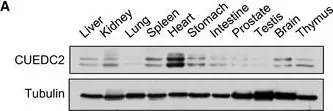
Fig.1.A
-
WB
-
Mus musculus (House mouse)
Collected and cropped from EMBO Molecular Medicine by CiteAb, provided under a CC-BY license
Image 1 of 11
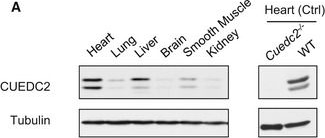
In EMBO Mol Med on 1 July 2016 by Jian, Z., Liang, B., et al.
Fig.8.A
-
WB
-
Mus musculus (House mouse)
Collected and cropped from EMBO Molecular Medicine by CiteAb, provided under a CC-BY license
Image 1 of 11
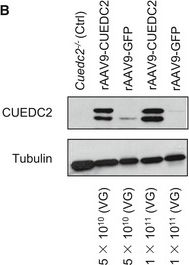
In EMBO Mol Med on 1 July 2016 by Jian, Z., Liang, B., et al.
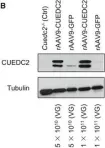
Fig.8.B
-
WB
-
Mus musculus (House mouse)
Collected and cropped from EMBO Molecular Medicine by CiteAb, provided under a CC-BY license
Image 1 of 11
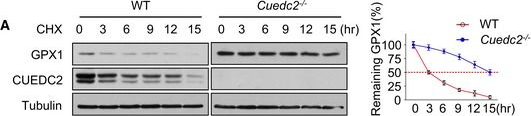
In EMBO Mol Med on 1 July 2016 by Jian, Z., Liang, B., et al.
Fig.5.A
-
WB
-
Mus musculus (House mouse)
Collected and cropped from EMBO Molecular Medicine by CiteAb, provided under a CC-BY license
Image 1 of 11
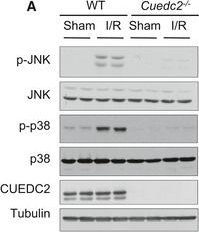
In EMBO Mol Med on 1 July 2016 by Jian, Z., Liang, B., et al.
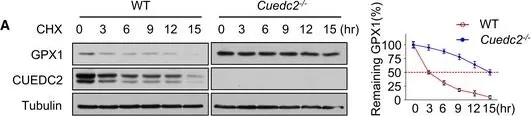
Fig.3.A
-
WB
-
Mus musculus (House mouse)
Collected and cropped from EMBO Molecular Medicine by CiteAb, provided under a CC-BY license
Image 1 of 11
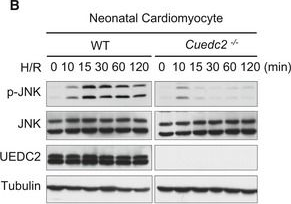
In EMBO Mol Med on 1 July 2016 by Jian, Z., Liang, B., et al.
Fig.3.B
-
WB
-
Mus musculus (House mouse)
Collected and cropped from EMBO Molecular Medicine by CiteAb, provided under a CC-BY license
Image 1 of 11
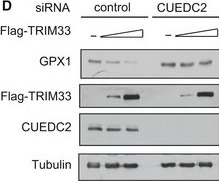
In EMBO Mol Med on 1 July 2016 by Jian, Z., Liang, B., et al.
Fig.6.D
-
WB
-
Mus musculus (House mouse)
Collected and cropped from EMBO Molecular Medicine by CiteAb, provided under a CC-BY license
Image 1 of 11
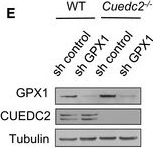
In EMBO Mol Med on 1 July 2016 by Jian, Z., Liang, B., et al.
Fig.4.E
-
WB
-
Mus musculus (House mouse)
Collected and cropped from EMBO Molecular Medicine by CiteAb, provided under a CC-BY license
Image 1 of 11
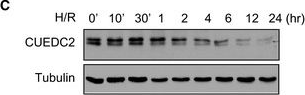
In EMBO Mol Med on 1 July 2016 by Jian, Z., Liang, B., et al.
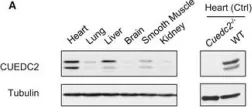
Fig.1.C
-
WB
-
Mus musculus (House mouse)
Collected and cropped from EMBO Molecular Medicine by CiteAb, provided under a CC-BY license
Image 1 of 11
In EMBO Mol Med on 1 July 2016 by Jian, Z., Liang, B., et al.
Fig.1.B
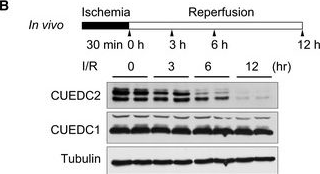
-
WB
-
Mus musculus (House mouse)
Collected and cropped from EMBO Molecular Medicine by CiteAb, provided under a CC-BY license
Image 1 of 11
In EMBO Mol Med on 1 July 2016 by Jian, Z., Liang, B., et al.
Fig.4.B
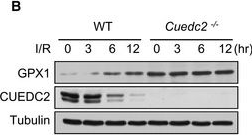
-
WB
-
Mus musculus (House mouse)
Collected and cropped from EMBO Molecular Medicine by CiteAb, provided under a CC-BY license
Image 1 of 11