Triple-negative breast cancer (TNBC) is an aggressive subtype of breast cancer with an unmet clinical need, but its epigenetic regulation remains largely undefined. By performing multiomic profiling, we recently revealed distinct super-enhancer (SE) patterns in different subtypes of breast cancer and identified a number of TNBC-specific SEs that drive oncogene expression. One of these SEs, TCOF1 SE, was discovered to play an important oncogenic role in TNBC. However, the molecular mechanisms by which TCOF1 SE promotes the expression of the TCOF1 gene remain to be elucidated. Here, by using combinatorial approaches of DNA pull-down assay, bioinformatics analysis and functional studies, we identified FOSL1 as a key transcription factor that binds to TCOF1 SE and drives its overexpression. shRNA-mediated depletion of FOSL1 results in significant downregulation of TCOF1 mRNA and protein levels. Using a dual-luciferase reporter assay and ChIP-qPCR, we showed that binding of FOSL1 to TCOF1 SE promotes the transcription of TCOF1 in TNBC cells. Importantly, our data demonstrated that overexpression of FOSL1 drives the activation of TCOF1 SE. Lastly, depletion of FOSL1 inhibits tumor spheroid growth and stemness properties of TNBC cells. Taken together, these findings uncover the key epigenetic role of FOSL1 and highlight the potential of targeting the FOSL1-TCOF1 axis for TNBC treatment.
© 2024. The Author(s).
Product Citations: 16
In Epigenetics & Chromatin on 10 November 2024 by He, Q., Hu, J., et al.
-
Homo sapiens (Human)
-
Cancer Research
-
Genetics
Vitamin D supplementation improves the therapeutic effect of mometasone on allergic rhinitis.
In Acta Biochimica Polonica on 16 September 2023 by Guo, M.
This study aimed to investigate the efficacy and safety of vitamin D supplementation in the treatment of allergic rhinitis (AR) using mometasone. A total of 140 patients with moderate and severe AR treated at our hospital between January 2017 and August 2020 were recruited as subjects for this study. The patients were randomly divided into control and experimental groups, with 70 patients in each group. Mometasone nasal spray was used in both groups, and vitamin D was administered to the experimental group for four weeks. The total nasal symptom scores (TNSS) and rhinoconjunctivitis quality of life questionnaire (RQLQ) were used to assess the efficacy of treatment. T lymphocyte subsets (CD3+, CD4+ and CD8+) and serum anti-inflammatory and proinflammatory cytokines such as interleukin-10 (IL-10), tumor necrosis factor-α (TNF-α), and interferon-γ (IFN-γ) were analyzed. The incidence of adverse reactions was recorded. Serum vitamin D levels were lower in patients with AR. After 4 weeks of treatment, total TNSS scores, T lymphocyte subsets (CD3+, CD4+), CD4+/CD8+ ratio, TNF-α, and total RQLQ scores were significantly reduced compared to the initial testing (P<0.05) in the two groups; CD8+, IFN-γ, and IL-10 levels as well as serum vitamin D were significantly increased compared to the initial test (P<0.05). The improvement in these parameters in the experimental group was significantly greater than that in the control group (P<0.05), except for sneezing and eye symptoms in the TNSS and RQLQ scores. It was concluded that vitamin D supplementation improves the therapeutic effect of mometasone nasal spray on AR and is thus recommended as an adjuvant therapy for moderate and severe AR.
-
Homo sapiens (Human)
In Genes Diseases on 1 March 2023 by Tian, Y., Li, J., et al.
-
FC/FACS
-
Cancer Research
In Stem Cell Reports on 10 January 2023 by Moya-Jódar, M., Ullate-Agote, A., et al.
Naive human pluripotent stem cells (hPSCs) are defined as the in vitro counterpart of the human preimplantation embryo's epiblast and are used as a model system to study developmental processes. In this study, we report the discovery and characterization of distinct cell populations coexisting with epiblast-like cells in 5iLAF naive human induced PSC (hiPSC) cultures. It is noteworthy that these populations closely resemble different cell types of the human embryo at early developmental stages. While epiblast-like cells represent the main cell population, interestingly we detect a cell population with gene and transposable element expression profile closely resembling the totipotent eight-cell (8C)-stage human embryo, and three cell populations analogous to trophectoderm cells at different stages of their maturation process: transition, early, and mature stages. Moreover, we reveal the presence of cells resembling primitive endoderm. Thus, 5iLAF naive hiPSC cultures provide an excellent opportunity to model the earliest events of human embryogenesis, from the 8C stage to the peri-implantation period.Copyright © 2022 The Authors. Published by Elsevier Inc. All rights reserved.
-
Stem Cells and Developmental Biology
MASTL is enriched in cancerous and pluripotent stem cells and influences OCT1/OCT4 levels.
In IScience on 17 June 2022 by Närvä, E., Taskinen, M. E., et al.
MASTL is a mitotic accelerator with an emerging role in breast cancer progression. However, the mechanisms behind its oncogenicity remain largely unknown. Here, we identify a previously unknown role and eminent expression of MASTL in stem cells. MASTL staining from a large breast cancer patient cohort indicated a significant association with β3 integrin, an established mediator of breast cancer stemness. MASTL silencing reduced OCT4 levels in human pluripotent stem cells and OCT1 in breast cancer cells. Analysis of the cell-surface proteome indicated a strong link between MASTL and the regulation of TGF-β receptor II (TGFBR2), a key modulator of TGF-β signaling. Overexpression of wild-type and kinase-dead MASTL in normal mammary epithelial cells elevated TGFBR2 levels. Conversely, MASTL depletion in breast cancer cells attenuated TGFBR2 levels and downstream signaling through SMAD3 and AKT pathways. Taken together, these results indicate that MASTL supports stemness regulators in pluripotent and cancerous stem cells.
© 2022 The Author(s).
-
Homo sapiens (Human)
-
Stem Cells and Developmental Biology
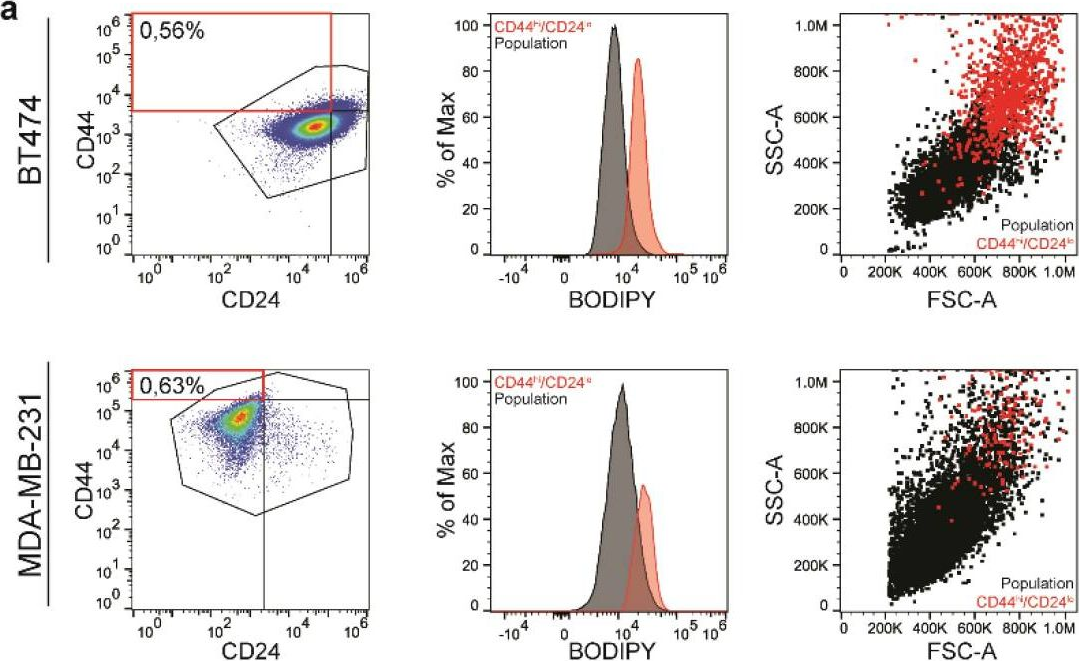
In J Clin Med on 29 December 2019 by Hershey, B. J., Vazzana, R., et al.
Fig.3.A
-
FC/FACS
-
Homo sapiens (Human)
Collected and cropped from Journal of Clinical Medicine by CiteAb, provided under a CC-BY license
Image 1 of 1