Albumin, a highly biocompatible protein, has been utilized in the construction of anti-cancer drugs for the treatment of various cancers. However, albumin-based nanomedicines still face several clinical challenges, including low stability in the bloodstream, non-specific targeting ability, and lack of controlled release capability. To address these limitations, we developed a multiprotein-based nanomedicine for targeted chemotherapy of non-small cell lung cancer (NSCLC). This nanomedicine was assembled using a heart-shaped albumin and two Y-shaped anti-CD44 and anti-CD133 antibodies. To enhance stability and improve therapeutic efficacy, the multiproteins were crosslinked using disulfide bond linkers and loaded with paclitaxel and ceramide. This resulted in nanomedicines that exhibited responsiveness to glutathione (GSH) and demonstrated inhibition of tumor cancer cells and cancer stem cells (CSCs). Our experimental results indicated that the inclusion of anti-CD44 and anti-CD133 antibodies enhanced the targeting capability of nanomedicines towards cancer cells and CSCs in an in vitro study and the accumulation in both normoxic regions and hypoxic niches in in vivo tumor xenografts. The multiprotein-based nanomedicines also demonstrated GSH-dependent drug release behavior, induced apoptosis in cancer cells and CSCs, inhibited cell migration, and effectively suppressed NSCLC tumor growth. Overall, our findings presented a novel nanostructure created from differently shaped proteins for application in drug delivery. This multiprotein-based nanomedicines showed promising potential in addressing the limitations of albumin-based nanomedicines and may offer improved therapeutic outcomes for cancer treatment.
© 2026. The Author(s).
Product Citations: 11

In Drug Delivery and Translational Research on 11 May 2026 by Yu, L. Y., Shueng, P. W., et al.
In Cancers on 12 May 2022 by Pal, P., Millner, A., et al.
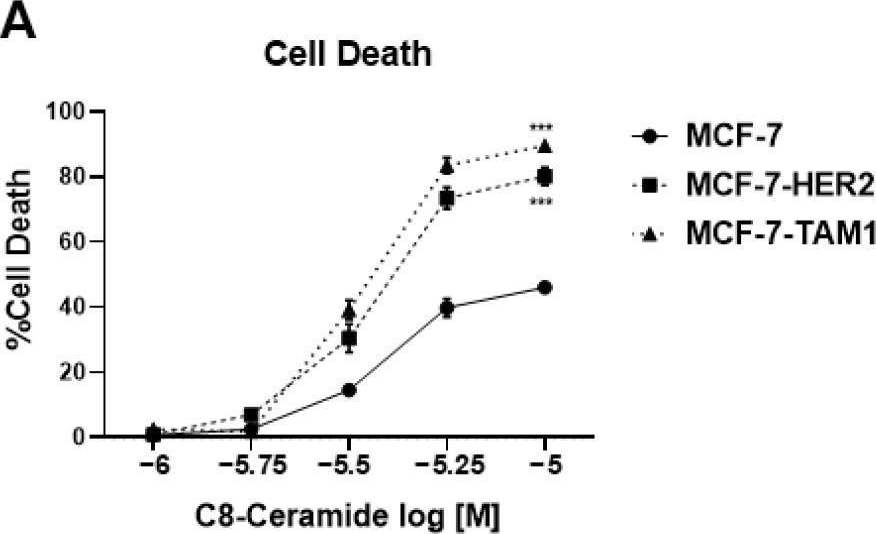
ET resistance is a critical problem for estrogen receptor-positive (ER+) breast cancer. In this study, we have investigated how alterations in sphingolipids promote cell survival in ET-resistant breast cancer. We have performed LC-MS-based targeted sphingolipidomics of tamoxifen-sensitive and -resistant MCF-7 breast cancer cell lines. Follow-up studies included treatments of cell lines and patient-derived xenograft organoids (PDxO) with small molecule inhibitors; cytometric analyses to measure cell death, proliferation, and apoptosis; siRNA-mediated knockdown; RT-qPCR and Western blot for gene and protein expression; targeted lipid analysis; and lipid addback experiments. We found that tamoxifen-resistant cells have lower levels of ceramides and hexosylceramides compared to their tamoxifen-sensitive counterpart. Upon perturbing the sphingolipid pathway with small molecule inhibitors of key enzymes, we identified that CERK is essential for tamoxifen-resistant breast cancer cell survival, as well as a fulvestrant-resistant PDxO. CERK inhibition induces ceramide-mediated cell death in tamoxifen-resistant cells. Ceramide-1-phosphate (C1P) partially reverses CERK inhibition-induced cell death in tamoxifen-resistant cells, likely through lowering endogenous ceramide levels. Our findings suggest that ET-resistant breast cancer cells maintain lower ceramide levels as an essential pro-survival mechanism. Consequently, ET-resistant breast cancer models have a unique dependence on CERK as its activity can inhibit de novo ceramide production.
In Addiction Biology on 1 November 2020 by Zoicas, I., Huber, S. E., et al.
Depression and alcohol dependence are associated with increased plasma ceramide concentrations in humans. Pharmacological increase in C16 ceramide concentrations in the dorsal hippocampus (DH) induced a depressive-like phenotype in naïve mice. However, the effects of C16 ceramide on alcohol consumption and anxiety-like behavior as well as the behavioral effects of other ceramide species are yet unknown. Therefore, we investigated whether repeated infusion of ceramides with different fatty acid chain lengths (C8, C16, and C20) into the DH and the basolateral amygdala (BLA) alter alcohol consumption, emotional behavior, and tissue monoamine levels. Our results revealed that C16, but not C8 and C20, ceramide altered alcohol drinking and emotional behavior in a brain region-specific way without altering tissue noradrenaline, dopamine, and serotonin levels in the prefrontal cortex, ventral striatum, and dorsal mesencephalon. In more detail, C16 ceramide increased alcohol consumption when infused into the BLA, but not when infused into the DH. Furthermore, C16 ceramide induced a depressive-like phenotype when infused into the DH, but a predominantly anxiogenic-like phenotype (in a non-social, but not a social context) when infused into the BLA. In turn, alcohol drinking normalized C16 ceramide-induced depressive-like and anxiogenic-like phenotypes. This study demonstrates a complex ceramide species-specific and brain region-specific modulation of alcohol consumption and emotional behavior in mice and provides the framework for future studies investigating the involvement of distinct ceramide species in the regulation of emotional behavior.© 2019 The Authors. Addiction Biology published by John Wiley & Sons Ltd on behalf of Society for the Study of Addiction.
In The Journal of Biological Chemistry on 18 September 2015 by Qi, Y., Wang, W., et al.
Aberrant deposition of fat including free fatty acids in the liver often causes damage to hepatocytes, namely lipotoxicity, which is a key pathogenic event in the development and progression of fatty liver diseases. This study demonstrates a pivotal role of sphingosine kinase 1 (SphK1) in protecting hepatocytes from lipotoxicity. Exposure of primary murine hepatocytes to palmitate resulted in dose-dependent cell death, which was enhanced significantly in Sphk1-deficient cells. In keeping with this, expression of dominant-negative mutant SphK1 also markedly promoted palmitate-induced cell death. In contrast, overexpression of wild-type SphK1 profoundly protected hepatocytes from lipotoxicity. Mechanistically, the protective effect of SphK1 is attributable to suppression of ER stress-mediated pro-apoptotic pathways, as reflected in the inhibition of IRE1α activation, XBP1 splicing, JNK phosphorylation, and CHOP induction. Of note, SphK1 inhibited the IRE1α pathway by reducing IRE1α expression at the transcriptional level. Moreover, S1P mimicked the effect of SphK1, suppressing IRE1α expression in a receptor-dependent manner. Furthermore, enforced overexpression of IRE1α significantly blocked the protective effect of SphK1 against lipotoxicity. Therefore, this study provides new insights into the role of SphK1 in hepatocyte survival and uncovers a novel mechanism for protection against ER stress-mediated cell death.© 2015 by The American Society for Biochemistry and Molecular Biology, Inc.
A ceramide analogue stimulates dendritic cells to promote T cell responses upon virus infections.
In The Journal of Immunology on 1 May 2015 by Pritzl, C. J., Seo, Y. J., et al.
The ceramide family of lipids plays important roles in both cell structure and signaling in a diverse array of cell types, including immune cells. However, very little is known regarding how ceramide affects the activation of dendritic cells (DCs) in response to viral infection. In this study, we demonstrate that a synthetic ceramide analog (C8) stimulates DCs to increase the expansion of virus-specific T cells upon virus infection. Exogenously supplied C8 ceramide elevated the expression of DC maturation markers such as MHC class I and costimulatory molecules following infection with the clone 13 strain of lymphocytic choriomeningitis virus (LCMV) or influenza virus. Importantly, ceramide-conditioned, LCMV-infected DCs displayed an increased ability to promote expansion of virus-specific CD8(+) T cells when compared with virus-infected DCs. Furthermore, a locally instilled ceramide analog significantly increased virus-reactive T cell responses in vivo to both LCMV and influenza virus infections. Collectively, these findings provide new insights into ceramide-mediated regulation of DC responses against virus infection and help us establish a foundation for novel immune-stimulatory therapeutics.Copyright © 2015 by The American Association of Immunologists, Inc.
In Cancers (Basel) on 12 May 2022 by Pal, P., Millner, A., et al.
Fig.5.A
Collected and cropped from Cancers by CiteAb, provided under a CC-BY license
Image 1 of 1