Inter-tissue interaction is fundamental to multicellularity. Although the basement membrane (BM) is located at tissue interfaces, its mode of action in inter-tissue interactions remains poorly understood, mainly because the molecular and structural details of the BM at distinct inter-tissue interfaces remain unclear. By combining quantitative transcriptomics and immunohistochemistry, we systematically identify the cellular origin, molecular identity and tissue distribution of extracellular matrix molecules in mouse hair follicles, and reveal that BM composition and architecture are exquisitely specialized for distinct inter-tissue interactions, including epithelial-fibroblast, epithelial-muscle and epithelial-nerve interactions. The epithelial-fibroblast interface, namely, hair germ-dermal papilla interface, makes asymmetrically organized side-specific heterogeneity in the BM, defined by the newly characterized interface, hook and mesh BMs. One component of these BMs, laminin α5, is required for hair cycle regulation and hair germ-dermal papilla anchoring. Our study highlights the significance of BM heterogeneity in distinct inter-tissue interactions.
Product Citations: 5

Applications
Reactivity
Research Area
In Nature Communications on 10 May 2021 by Tsutsui, K., Machida, H., et al.
In Cell Death & Disease on 3 November 2016 by Chu, Q., Huang, H., et al.
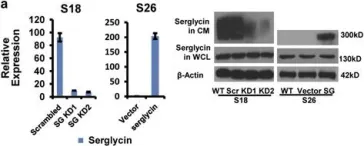
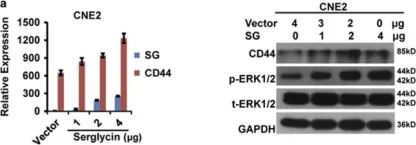
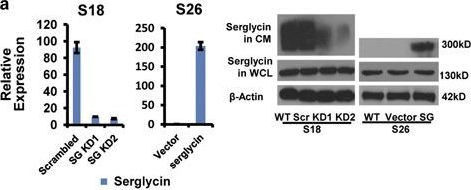
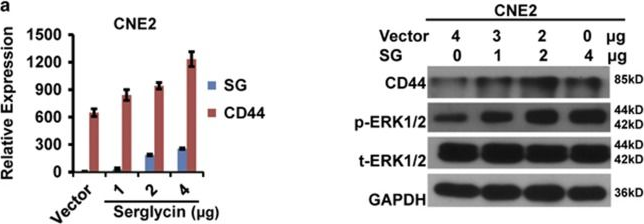
Serglycin is a proteoglycan that was first found to be secreted by hematopoietic cells. As an extracellular matrix (ECM) component, serglycin promotes nasopharyngeal carcinoma (NPC) metastasis and serves as an independent, unfavorable NPC prognostic indicator. The detailed mechanism underlying the roles of serglycin in cancer progression remains to be clarified. Here, we report that serglycin knockdown in NPC cells inhibited cell sphere formation and tumor seeding abilities. Serglycin downregulation enhanced high-metastasis NPC cell sensitivity to chemotherapy. It has been reported that serglycin is a novel ligand for the stem cell marker CD44. Interestingly, we found a positive correlation between serglycin expression and CD44 in nasopharyngeal tissues and NPC cell lines. Further study revealed that CD44 was an ERK-dependent downstream effector of serglycin signaling, and serglycin activated the MAPK/β-catenin axis to induce CD44 receptor expression in a positive feedback loop. Taken together, our novel findings suggest that ECM serglycin upregulated CD44 receptor expression to maintain NPC stemness by interacting with CD44 and activating the MAPK/β-catenin pathway, resulting in NPC cell chemoresistance. These findings suggest that the intervention of serglycin/CD44 axis and downstream signaling pathway is a rational strategy for targeting NPC cancer stem cell therapy.
-
WB
-
Homo sapiens (Human)
-
Cancer Research
-
Cell Biology
-
Endocrinology and Physiology
In Biochimica et Biophysica Acta on 1 August 2014 by Reine, T. M., Vuong, T. T., et al.
Endothelial cells have important functions in e.g. regulating blood pressure, coagulation and host defense reactions. Serglycin is highly expressed by endothelial cells, but there is limited data on the roles of this proteoglycan in immune reactions.
Cultured primary human endothelial cells were exposed to proinflammatory agents lipopolysaccharide (LPS) and interleukin 1β (IL-1β). The response in serglycin synthesis, secretion and intracellular localization and effect on the proteoglycan binding chemokines CXCL-1 and CXCL-8 were determined by qRT-PCR, Western blotting, immunocytochemistry, ELISA and serglycin knockdown experiments.
Both LPS and IL-1β increased the synthesis and secretion of serglycin, while only IL-1β increased serglycin mRNA expression. Stimulation increased the number of serglycin containing vesicles, with a greater portion of large vesicles after LPS treatment. Also, increased intracellular and secreted levels of CXCL-1 and CXCL-8 were observed. The increase in CXCL-8 secretion was unchanged in serglycin knockdown cells. However, the increase in CXCL-1 secretion from IL-1β stimulation was reduced 27% in serglycin knockdown cells; while the LPS-induced secretion was not affected. In serglycin expressing cells CXCL-1 positive vesicles were evenly distributed throughout the cytoplasm, while confided to the Golgi region in serglycin knockdown cells. This was the case only for IL-1β stimulated cells. LPS-induced CXCL-1 distribution was unaffected by serglycin expression.
These results suggest that different signaling pathways are involved in regulating secretion of serglycin and partner molecules in activated endothelial cells.
This knowledge increases our understanding of the roles of serglycin in immune reactions. This article is part of a Special Issue entitled: Matrix-mediated cell behaviour and properties.
Copyright © 2014 Elsevier B.V. All rights reserved.
-
IP
-
Homo sapiens (Human)
-
Biochemistry and Molecular biology
-
Immunology and Microbiology
In Biochimica et Biophysica Acta on 1 June 2014 by Gasimli, L., Hickey, A. M., et al.
Proteoglycans are found on the cell surface and in the extracellular matrix, and serve as prime sites for interaction with signaling molecules. Proteoglycans help regulate pathways that control stem cell fate, and therefore represent an excellent tool to manipulate these pathways. Despite their importance, there is a dearth of data linking glycosaminoglycan structure within proteoglycans with stem cell differentiation.Human embryonic stem cell line WA09 (H9) was differentiated into early mesoderm and endoderm lineages, and the glycosaminoglycanomic changes accompanying these transitions were studied using transcript analysis, immunoblotting, immunofluorescence and disaccharide analysis.Pluripotent H9 cell lumican had no glycosaminoglycan chains whereas in splanchnic mesoderm lumican was glycosaminoglycanated. H9 cells have primarily non-sulfated heparan sulfate chains. On differentiation towards splanchnic mesoderm and hepatic lineages N-sulfo group content increases. Differences in transcript expression of NDST1, HS6ST2 and HS6ST3, three heparan sulfate biosynthetic enzymes, within splanchnic mesoderm cells compared to H9 cells correlate to changes in glycosaminoglycan structure.Differentiation of embryonic stem cells markedly changes the proteoglycanome.The glycosaminoglycan biosynthetic pathway is complex and highly regulated, and therefore, understanding the details of this pathway should enable better control with the aim of directing stem cell differentiation.Copyright © 2013 Elsevier B.V. All rights reserved.
-
WB
-
Homo sapiens (Human)
-
Biochemistry and Molecular biology
-
Stem Cells and Developmental Biology
Serglycin is a theranostic target in nasopharyngeal carcinoma that promotes metastasis.
In Cancer Research on 15 April 2011 by Li, X. J., Ong, C. K., et al.
Nasopharyngeal carcinoma (NPC) is known for its high-metastatic potential. Here we report the identification of the proteoglycan serglycin as a functionally significant regulator of metastasis in this setting. Comparative genomic expression profiling of NPC cell line clones with high- and low-metastatic potential revealed the serglycin gene (SRGN) as one of the most upregulated genes in highly metastatic cells. RNAi-mediated inhibition of serglycin expression blocked serglycin secretion and the invasive motility of highly metastatic cells, reducing metastatic capacity in vivo. Conversely, serglycin overexpression in poorly metastatic cells increased their motile behavior and metastatic capacity in vivo. Growth rate was not influenced by serglycin in either highly or poorly metastatic cells. Secreted but not bacterial recombinant serglycin promoted motile behavior, suggesting a critical role for glycosylation in serglycin activity. Serglycin inhibition was associated with reduced expression of vimentin but not other epithelial-mesenchymal transition proteins. In clinical specimens, serglycin expression was elevated significantly in liver metastases from NPC relative to primary NPC tumors. We evaluated the prognostic value of serglycin by immunohistochemical staining of tissue microarrays from 263 NPC patients followed by multivariate analyses. High serglycin expression in primary NPC was found to be an unfavorable independent indicator of distant metastasis-free and disease-free survival. Our findings establish that glycosylated serglycin regulates NPC metastasis via autocrine and paracrine routes, and that it serves as an independent prognostic indicator of metastasis-free survival and disease-free survival in NPC patients.
©2011 AACR.
-
IHC
-
WB
-
Homo sapiens (Human)
-
Cancer Research
In Cell Death Dis on 3 November 2016 by Chu, Q., Huang, H., et al.
Fig.2.A
-
WB
-
Homo sapiens (Human)
Collected and cropped from Cell Death & Disease by CiteAb, provided under a CC-BY license
Image 1 of 2
In Cell Death Dis on 3 November 2016 by Chu, Q., Huang, H., et al.
Fig.5.A
-
WB
-
Homo sapiens (Human)
Collected and cropped from Cell Death & Disease by CiteAb, provided under a CC-BY license
Image 1 of 2