The early microbial colonization of the gastrointestinal tract can have long-term impacts on development and health. Keystone species, including Bacteroides spp., are prominent in early life and play crucial roles in maintaining the structure of the intestinal ecosystem. However, the process by which a resilient community is curated during early life remains inadequately understood. Here, we show that a single sialidase, NanH, in Bacteroides fragilis mediates stable occupancy of the intestinal mucosa in early life and regulates a commensal colonization program. This program is triggered by sialylated glycans, including those found in human milk oligosaccharides and intestinal mucus. NanH is required for vertical transmission from dams to pups and promotes B. fragilis dominance during early life. Furthermore, NanH facilitates commensal resilience and recovery after antibiotic treatment in a defined microbial community. Collectively, our study reveals a co-evolutionary mechanism between the host and microbiota mediated through host-derived glycans to promote stable colonization.
Copyright © 2023 Elsevier Inc. All rights reserved.
Product Citations: 10

A bacterial sialidase mediates early-life colonization by a pioneering gut commensal.
In Cell Host & Microbe on 14 February 2024 by Buzun, E., Hsu, C. Y., et al.
In Nature Communications on 8 December 2023 by Ding, X., Robbe-Masselot, C., et al.
Staphylococcus aureus is a predominant cause of chronic lung infections. While the airway environment is rich in highly sialylated mucins, the interaction of S. aureus with sialic acid is poorly characterized. Using S. aureus USA300 as well as clinical isolates, we demonstrate that quorum-sensing dysfunction, a hallmark of S. aureus adaptation, correlates with a greater ability to consume free sialic acid, providing a growth advantage in an air-liquid interface model and in vivo. Furthermore, RNA-seq experiment reveals that free sialic acid triggers transcriptional reprogramming promoting S. aureus chronic lifestyle. To support the clinical relevance of our results, we show the co-occurrence of S. aureus, sialidase-producing microbiota and free sialic acid in the airway of patients with cystic fibrosis. Our findings suggest a dual role for sialic acid in S. aureus airway infection, triggering virulence reprogramming and driving S. aureus adaptive strategies through the selection of quorum-sensing dysfunctional strains.
© 2023. The Author(s).
In Beilstein Journal of Organic Chemistry on 15 March 2022 by de Andrade, P., Ahmadipour, S., et al.
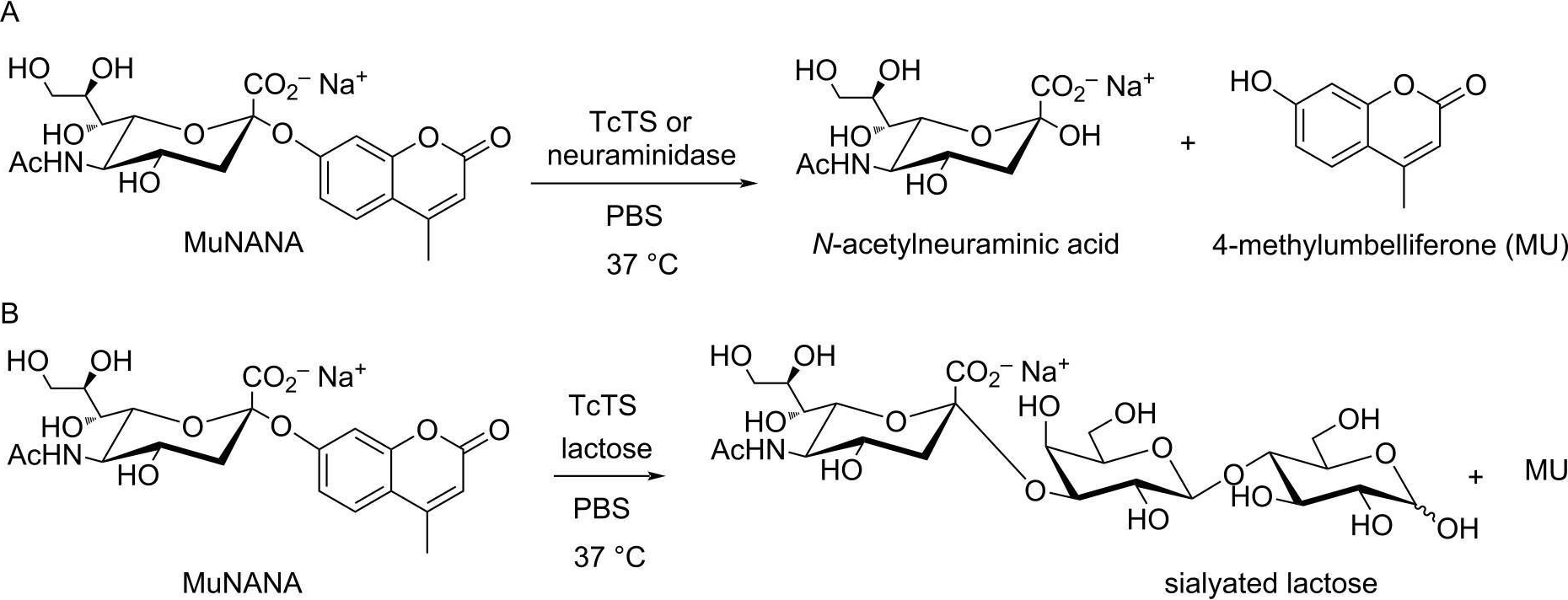
Sialic acid is the natural substrate for sialidases and its chemical modification has been a useful approach to generate potent and selective inhibitors. Aiming at advancing the discovery of selective Trypanosoma cruzi trans-sialidase (TcTS) inhibitors, we have synthesised a small series of anomeric 1,2,3-triazole-linked sialic acid derivatives in good yields and high purity via copper-catalysed azide-alkyne cycloaddition (CuAAC, click chemistry) and evaluated their activity towards TcTS and neuraminidase. Surprisingly, the compounds showed practically no TcTS inhibition, whereas ca. 70% inhibition was observed for neuraminidase in relation to the analogues bearing hydrophobic substituents and ca. 5% for more polar substituents. These results suggest that polarity changes are less tolerated by neuraminidase due to the big difference in impact of hydrophobicity upon inhibition, thus indicating a simple approach to differentiate both enzymes. Moreover, such selectivity might be reasoned based on a possible steric hindrance caused by a bulky hydrophobic loop that sits over the TcTS active site and may prevent the hydrophobic inhibitors from binding. The present study is a step forward in exploiting subtle structural differences in sialidases that need to be addressed in order to achieve selective inhibition.
Copyright © 2022, de Andrade et al.
In GLIA on 1 December 2021 by Liao, H., Winkler, J., et al.
Parkinson's disease is one of the most common neurodegenerative diseases in the elderly population, with a pathophysiology linked to neuroinflammation, complement activation, and oxidative damage. Soluble polysialic acid with an average degree of polymerization 20 (polySia avDP20) prevents inflammation and oxidative burst in human macrophages via sialic acid-binding immunoglobulin like lectin-11 (SIGLEC11) receptor and interferes with alternative complement activation. Here, we confirmed the anti-inflammatory capacity of polySia avDP20 on cultured murine embryonic stem cell-derived microglia and analyzed the effect of polySia avDP20 in a lipopolysaccharide-triggered animal model of Parkinson's disease. We demonstrated a neuroprotective effect of intraperitoneally applied polySia avDP20 in humanized SIGLEC11 transgenic mice after repeated systemic challenge with lipopolysaccharide. Pathway enrichment analysis of the brain transcriptome on day 19 after disease initiation showed that intraperitoneal application of 10 μg/g body weight polySia avDP20 prevented excessive inflammation. In line with these data, polySia avDP20 attenuated the lipopolysaccharide-triggered increase in mRNA levels of immune-related genes (Il1b, Cd14, Myd88, Fcer1g, Itgam, C4, Cybb, Iba1 and Cd68) and cell death-related genes (Casp8, Ripk1 and Ripk3) in the brains of SIGLEC11 transgenic mice on day 19, but not on day 5. Moreover, immunohistochemistry demonstrated that polySia avDP20 reduced the lipopolysaccharide-induced increase in immunoreactivity of IBA1 and CD68 in the substantia nigra pars reticulata in SIGLEC11 transgenic and wild type mice on day 19. Furthermore, treatment with polySia avDP20 prevented the loss of dopaminergic neurons in the substantia nigra pars compacta induced by lipopolysaccharide challenge in both SIGLEC11 transgenic and wild type mice on day 19. Thus, our data demonstrate that polySia avDP20 ameliorates inflammatory dopaminergic neurodegeneration and therefore is a promising drug candidate to prevent Parkinson's disease-related inflammation and neurodegeneration.
© 2021 The Authors. GLIA published by Wiley Periodicals LLC.
Small RNAs are modified with N-glycans and displayed on the surface of living cells.
In Cell on 10 June 2021 by Flynn, R. A., Pedram, K., et al.
Glycans modify lipids and proteins to mediate inter- and intramolecular interactions across all domains of life. RNA is not thought to be a major target of glycosylation. Here, we challenge this view with evidence that mammals use RNA as a third scaffold for glycosylation. Using a battery of chemical and biochemical approaches, we found that conserved small noncoding RNAs bear sialylated glycans. These "glycoRNAs" were present in multiple cell types and mammalian species, in cultured cells, and in vivo. GlycoRNA assembly depends on canonical N-glycan biosynthetic machinery and results in structures enriched in sialic acid and fucose. Analysis of living cells revealed that the majority of glycoRNAs were present on the cell surface and can interact with anti-dsRNA antibodies and members of the Siglec receptor family. Collectively, these findings suggest the existence of a direct interface between RNA biology and glycobiology, and an expanded role for RNA in extracellular biology.Copyright © 2021 Elsevier Inc. All rights reserved.
In Beilstein J Org Chem on 15 March 2022 by de Andrade, P., Ahmadipour, S., et al.
Fig.3.A
Collected and cropped from Beilstein Journal of Organic Chemistry by CiteAb, provided under a CC-BY license
Image 1 of 1